Automate HVAC inspections

Sensors tell you what you decided to measure.
A humanoid shows you what sensors can’t see.
3 Key Reasons
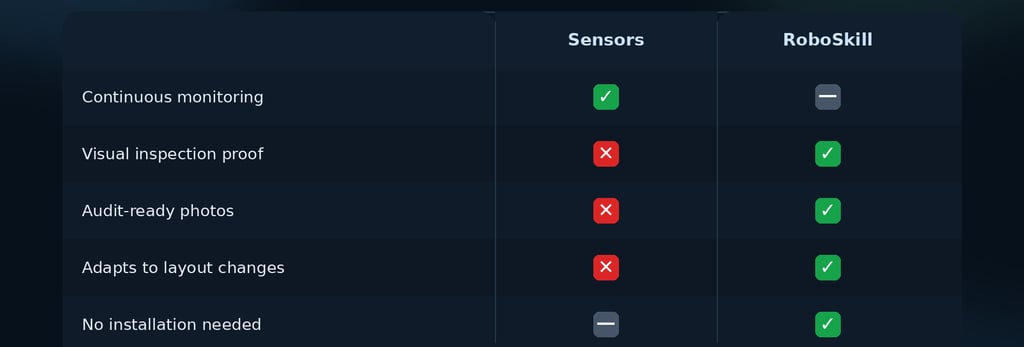
1. Sensors can’t see physical problems
Sensors are great at numbers.
They are not great at visual condition.
Our humanoid can help spot:
Dust buildup
Blocked vents
Water stains
Condensation
Loose or open panels
Damaged insulation
Temporary obstructions
These are the exact kinds of issues that still require walk-throughs.
2. Sensors can’t provide inspection proof on their own
Many facilities do not just need readings.
They need evidence.
Our humanoid helps create:
Time-stamped photos
Repeatable route logs
Visual proof of inspection
Consistent records for reviews and audits
That means less dependence on manual note-taking and more confidence that rounds were actually completed.
3. Sensors can’t adapt when the facility changes
Facilities change all the time:
New equipment gets added
Aisles get blocked
Panels get left open
Temporary fixes become permanent problems
Layouts shift over time
Sensors stay where they were installed.
A humanoid inspection layer moves through the space as it exists today.
Sensors are essential. Every serious facility uses them, and so do we. But sensors only report the points you installed, configured, and maintained. They do not see dust buildup, blocked vents, loose panels, water stains, or the small physical issues that technicians still walk the site to catch. That is why the question is not sensors or robot. It is how to combine both to reduce manual inspections, improve documentation, and catch more problems before they grow.
Modern facilities rely heavily on sensors to monitor temperature, airflow, power, and safety systems. Sensors provide continuous data about how equipment is operating.
However, sensors cannot replace physical inspections. Robotic inspections add a visual verification layer that complements existing monitoring systems.
How they work together
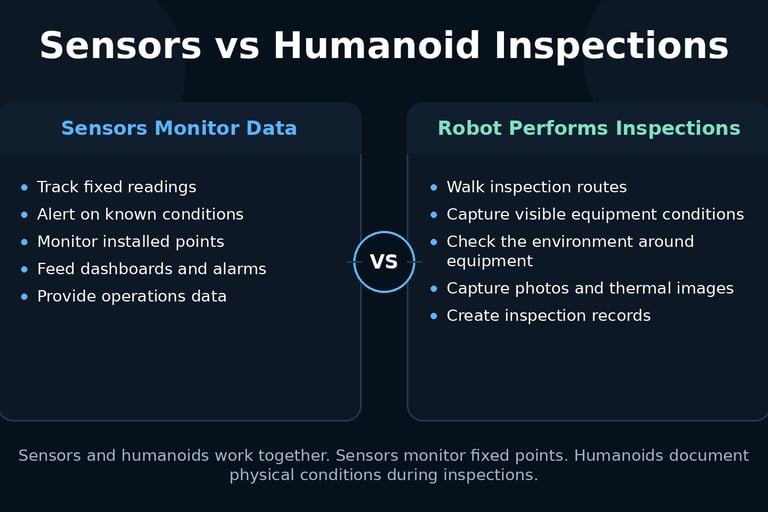
We do not replace your sensors. We work on top of them.
Your existing sensors continue doing what they do best: continuous monitoring of known conditions. Our humanoid adds the inspection and documentation layer that sensors do not provide. Deployment can start in a non-invasive way by reading visible screens, gauges, indicator lights, and physical conditions during routine rounds. That means no wiring changes, no control-system changes, and no IT access required to get started.
"The fact that technicians still walk your facility today is proof that sensors alone are not enough."
See how humanoid inspection works in a real facility.
Why Facilities Still Perform Walk-Through Inspections
Even with advanced monitoring systems, technicians still perform regular inspection rounds.
These inspections are required for several reasons:
• Visual verification of equipment conditions
• Safety checks in mechanical and electrical rooms
• Confirmation that alarms correspond to real conditions
• Compliance with maintenance procedures and audits
• Documentation of facility conditions
Many industry standards and operating procedures still require visual inspection evidence.